

Denis Fedosov
Expert in technical supervision and real estate acceptance
Do you live in the EU, the UK, or the US, and are you renovating a property in Cyprus? Learn from a practicing consulting engineer how to protect your investment and get a high-quality result.
Why Even New Property Needs an Inspection Before Purchase
Every year, hundreds of new residential complexes appear in Cyprus, boasting impressive facades, spacious terraces, and promises of “European quality.” Developers claim that new buildings don’t need inspections: everything is built to standards, everything is new, so it must be reliable.
But Hinode experts know the reality: even freshly completed homes can hide dozens of defects. These are not just minor scratches or uneven tiles — these are issues that over time can turn into serious financial losses for the owner. An inspection before purchase is not a formality — it’s a necessary step to protect your capital and peace of mind.
Why New Buildings Are Far from Perfect
Modern developers in Cyprus work under high competition and tight deadlines. Rushed projects, subcontractors without proper oversight, and cost-saving on supervision often result in properties being handed over “on time” but not up to quality standards.
Contractors may rush finishing works, ignoring technological pauses: plaster applied to damp walls, tiles laid without leveling the base, insulation materials chosen cheaply. As a result, the buyer sees a beautiful picture that may start cracking or leaking within months.
Hinode engineers regularly document cases where properties costing €300,000 or more have:
- Improper ventilation
- Outlets wired with reversed polarity
- Weak water pressure
- Defective plumbing connections
- Overloaded electrical circuits
- Poor sound insulation
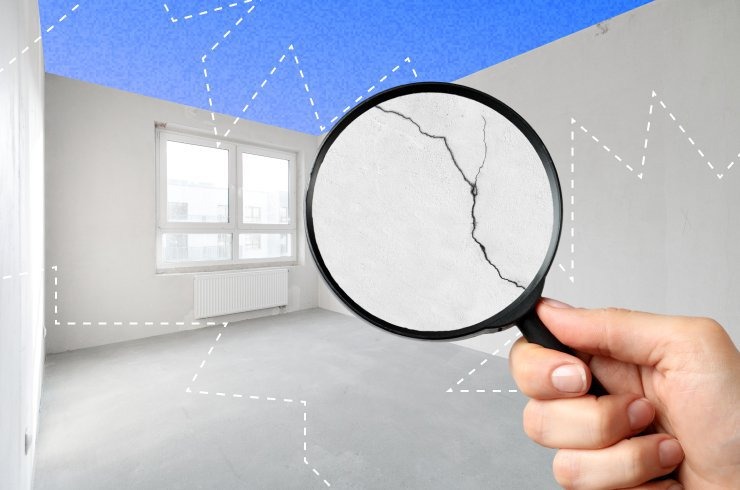
Typical Hidden Problems in New Buildings
Common defects include:
- Cracks in walls and ceilings
- Misaligned door frames
- Uneven floors
- Gaps in window frames
Many problems are hidden below the surface: weak water pressure, faulty plumbing joints, overloaded electrical lines, poor soundproofing. Conditionally installed air conditioners without drainage can eventually damage walls.
For the buyer, these “small issues” turn into unexpected expenses, from repairs to legal disputes with the developer. That’s why a technical inspection before purchase is a tool for protection, not a luxury.
How Independent Expertise Reveals Defects
Hinode conducts a comprehensive inspection:
- Visual examination
- Measurements of geometry and surfaces
- Verification of engineering systems
- Document checks
Professional tools used include: moisture meters, laser levels, thermal cameras, and leak detectors.
Every defect is recorded in a snagging report with photos, comments, and recommendations for correction. If the property does not meet the project or building standards, the client is informed before signing the certificate, allowing them to:
- Request repairs at the developer’s expense
- Negotiate the purchase price

Why Even “Premium” Developers Cut Corners
It’s a misconception that only budget complexes have problems. Even elite projects in Cyprus often substitute materials:
- Cheap plumbing instead of German fixtures
- Poor screed hidden under expensive parquet
The reason is simple: the developer’s responsibility ends at handover, and fixing defects after the sale is not a priority. That’s why Hinode experts always recommend an independent inspection, even in the premium segment. The higher the property price, the more expensive the mistakes.
Hinode helps investors and buyers in Cyprus take possession of property without risks — checking construction quality, finishes, engineering systems, and documents. A new building may be “new,” but only an expert inspection confirms if it’s truly flawless.
Revealing the truth about construction defects and poor finishes in Cyprus — and how to avoid losses.
featured
-
1What differentiates the handover of residential and commercial properties
The property handover process in Cyprus requires an understanding of how the property will be used. In residential apartments, the priority is occupant comfort and health, while in commercial buildings, economic efficiency and system reliability come first. Any deviations in the building’s thermal profile, if unnoticed, can lead to significant future expenses for the owner. […]
-
2How to know during inspection whether mold will appear
The visual cleanliness of walls during a property inspection can be misleading, especially if a cosmetic renovation was done before the sale. Mold is not just an aesthetic issue—it results from serious engineering mistakes that can remain hidden under paint for years. For investors in Cyprus, it is critical to detect biological threats at the […]
-
3Practical examples: What to check during the handover of a residential property
The handover of a property is the final stage of a transaction, where the buyer confirms that the asset is ready for use. In the Cypriot market, where aesthetics often take priority over technical quality, a superficial inspection cannot reveal critical risks. An expert audit should cover not only visible finishing elements but also hidden […]
-
4Practical Examples: What to Check When Accepting Commercial Property
Purchasing commercial real estate is an investment whose profitability directly depends on future operating costs. Unlike residential properties, office buildings and shopping centers in Cyprus are subject to intense эксплуатационные нагрузки. Any flaws in the building’s thermal performance force HVAC systems to operate under strain, increasing electricity costs and accelerating wear on expensive equipment. Key […]
-
5Why Thermal Imaging Is Essential During Property Handover
Accepting a property requires evaluating not only visible finishes but also hidden structural characteristics. Issues with insulation, installation errors in engineering systems, and energy leaks are often impossible to detect without specialized equipment. Thermal imaging diagnostics make it possible to identify such defects at an early stage and prevent future operational problems. What a Thermal […]