
Denis Fedosov
Expert in technical supervision and real estate acceptance
Do you live in the EU, the UK, or the US, and are you renovating a property in Cyprus? Learn from a practicing consulting engineer how to protect your investment and get a high-quality result.
Why Thermal Imaging Is Essential During Property Handover
Accepting a property requires evaluating not only visible finishes but also hidden structural characteristics. Issues with insulation, installation errors in engineering systems, and energy leaks are often impossible to detect without specialized equipment. Thermal imaging diagnostics make it possible to identify such defects at an early stage and prevent future operational problems.
What a Thermal Imager Reveals and Why It Matters
Thermal imaging inspection is a non-destructive testing method based on detecting infrared radiation emitted by objects. Every building has its own thermal profile, and any deviation from this profile indicates anomalies within walls, slabs, or engineering systems.
This is especially important during property handover from the developer, as it allows defects to be documented before they lead to failures or costly repairs.
Professional analysis involves more than simply pointing a device at a wall. Experts must account for differences in emissivity between materials and the impact of solar radiation on building surfaces. A high-quality thermal imager (with NETD sensitivity below 40–50 mK) can detect temperature differences of just fractions of a degree, producing detailed thermograms.
When analyzing results, specialists focus on zones of abnormal heating or cooling, which may indicate:
- Air leakage through windows and door openings
- Moisture accumulation inside walls, a precursor to mold
- Uneven heating in underfloor heating systems (air pockets or pipe deformation)
- Overheating electrical connections in distribution panels
- Hidden leaks in water supply or drainage systems
These findings form the basis of a defect report. Identifying such issues early allows the buyer to demand corrections under warranty, preserving the property’s value.
Detecting Hidden Issues with Insulation and Systems
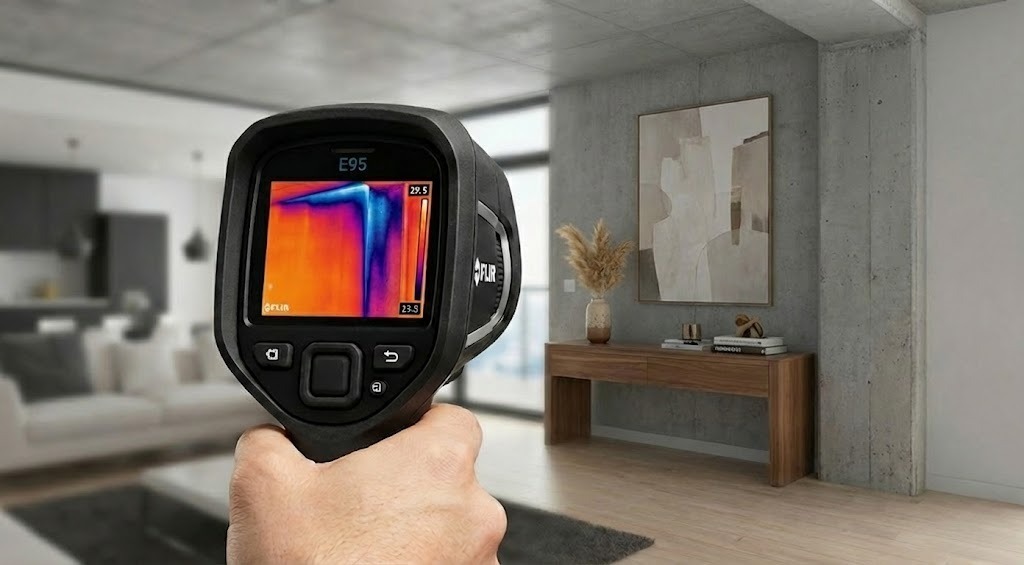
Properties in Cyprus often suffer from so-called “thermal bridges”—areas of increased heat conductivity, typically found in reinforced concrete columns, structural beams, or slab-to-wall connections.
Without proper thermal imaging, these zones become constant sources of energy loss, forcing climate control systems to operate at maximum capacity.
When it comes to utilities, thermal imaging is often the only way to “see” beneath plaster or flooring without damaging finishes. As modern villas and apartments become more complex, the risk of installation errors increases.
Hidden issues frequently stem from improper installation of insulation materials. Gaps or damage in insulation create zones of reduced thermal resistance, shifting the dew point inside the building. This leads to moisture damage and deterioration of interior finishes. Thermal imaging not only detects such defects but also determines their scale—crucial for estimating repair costs.
Defects Detectable Only with Thermal Imaging
In practice, even premium properties can contain serious defects concealed behind high-quality finishes. Without thermal imaging, buyers may not understand why electricity bills are unusually high or why certain rooms feel persistently damp.
A common example is a broken insulation layer in the roof. On a thermogram, this appears as bright hot spots on the ceiling during summer. Similarly, improper installation of aluminum window profiles with thermal breaks can be detected—if installed incorrectly, they conduct heat, negating their benefits.
Typical issues revealed through thermal inspection include:
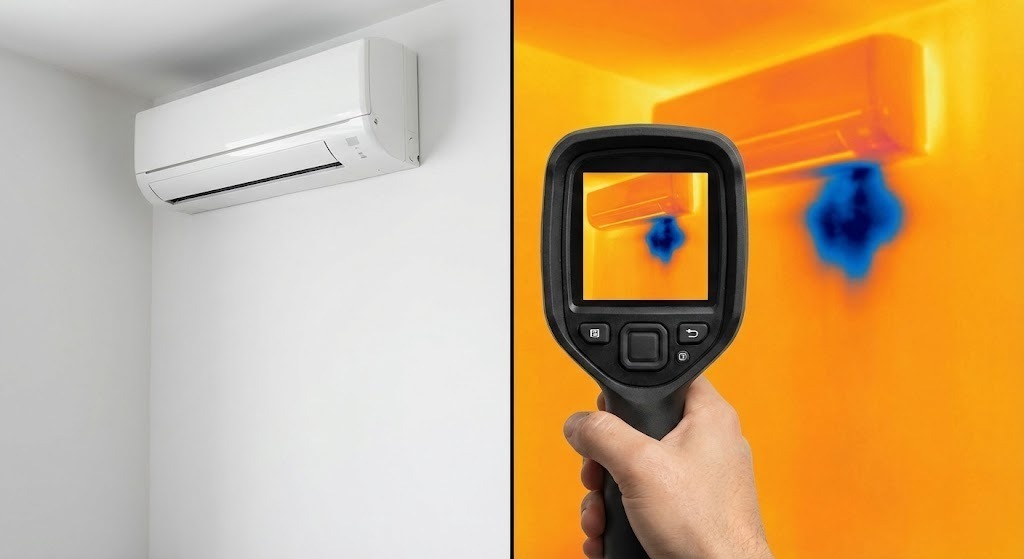
- Microcracks in air conditioning pipes hidden in walls (seen as localized cooling zones)
- Missing expansion joints in underfloor heating systems, leading to floor cracking
- Oxidized electrical contacts appearing as hot spots in panels
- Blockages in radiators causing uneven heat distribution
If left undetected, these issues can trigger a chain of damage. For example, a small leak in an AC system can lead not only to equipment failure but also to damage of expensive finishes, requiring partial demolition for repair.
How Hinode Conducts Professional Thermal Imaging
To obtain legally valid and technically accurate results, inspections must follow strict international standards. Random or unstructured measurements are not sufficient.
Proper preparation is essential. A temperature difference of at least 10–15°C between indoor and outdoor environments is typically required. In Cyprus, this often involves preconditioning the space using climate control systems.
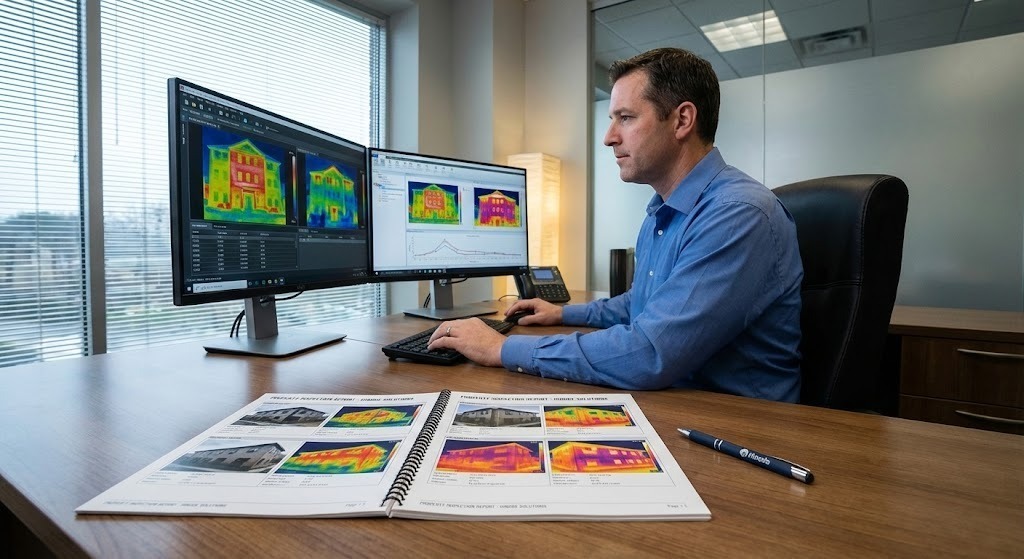
Hinode follows a comprehensive diagnostic process that includes both on-site scanning and detailed data analysis. Each detected anomaly is cross-checked against project specifications and building standards to eliminate false positives caused by reflections or natural thermal inertia.
The process includes:
- Reviewing project specifications to understand expected thermal performance
- Calibrating equipment based on humidity, distance, and environmental conditions
- Producing detailed reports with thermograms overlaid on real images for clarity
The final result is an official report that serves as strong evidence in negotiations with the developer. Having such documentation from Hinode significantly increases the likelihood that defects will be corrected at the developer’s expense.
Conclusion
Thermal imaging is not just an optional extra—it is the only reliable way to detect hidden defects without damaging the property. It ensures that you are paying for real quality, not just a visually appealing finish with concealed flaws.
Hinode uses thermal imaging to detect hidden defects in residential and commercial real estate.
featured
-
1What differentiates the handover of residential and commercial properties
The property handover process in Cyprus requires an understanding of how the property will be used. In residential apartments, the priority is occupant comfort and health, while in commercial buildings, economic efficiency and system reliability come first. Any deviations in the building’s thermal profile, if unnoticed, can lead to significant future expenses for the owner. […]
-
2How to know during inspection whether mold will appear
The visual cleanliness of walls during a property inspection can be misleading, especially if a cosmetic renovation was done before the sale. Mold is not just an aesthetic issue—it results from serious engineering mistakes that can remain hidden under paint for years. For investors in Cyprus, it is critical to detect biological threats at the […]
-
3Practical examples: What to check during the handover of a residential property
The handover of a property is the final stage of a transaction, where the buyer confirms that the asset is ready for use. In the Cypriot market, where aesthetics often take priority over technical quality, a superficial inspection cannot reveal critical risks. An expert audit should cover not only visible finishing elements but also hidden […]
-
4Practical Examples: What to Check When Accepting Commercial Property
Purchasing commercial real estate is an investment whose profitability directly depends on future operating costs. Unlike residential properties, office buildings and shopping centers in Cyprus are subject to intense эксплуатационные нагрузки. Any flaws in the building’s thermal performance force HVAC systems to operate under strain, increasing electricity costs and accelerating wear on expensive equipment. Key […]
-
5Why Thermal Imaging Is Essential During Property Handover
Accepting a property requires evaluating not only visible finishes but also hidden structural characteristics. Issues with insulation, installation errors in engineering systems, and energy leaks are often impossible to detect without specialized equipment. Thermal imaging diagnostics make it possible to identify such defects at an early stage and prevent future operational problems. What a Thermal […]