
Denis Fedosov
Expert in technical supervision and real estate acceptance
Do you live in the EU, the UK, or the US, and are you renovating a property in Cyprus? Learn from a practicing consulting engineer how to protect your investment and get a high-quality result.
Practical Examples: What to Check When Accepting Commercial Property
Purchasing commercial real estate is an investment whose profitability directly depends on future operating costs. Unlike residential properties, office buildings and shopping centers in Cyprus are subject to intense эксплуатационные нагрузки. Any flaws in the building’s thermal performance force HVAC systems to operate under strain, increasing electricity costs and accelerating wear on expensive equipment.
Key Features of Commercial Properties
For commercial buildings, maintaining a continuous insulation envelope is critical—especially in roof areas and façade glazing systems. Defects in these zones appear on thermograms as bright spots, indicating uncontrolled energy loss. Even in premium properties, such issues are often concealed beneath high-quality finishes, making visual inspection ineffective.
During audits of commercial spaces, the following technical risks are commonly identified:
- Thermal bridges in reinforced concrete columns and structural beams typical of Cyprus construction
- Damaged or poorly installed insulation, creating zones of reduced thermal resistance
- Incorrect installation of aluminum profiles with thermal breaks, reducing glazing efficiency
Detecting these issues at the handover stage allows investors to document defects before they turn into ongoing financial losses.
Inspection of Engineering Systems and Utilities
The engineering infrastructure of business centers is significantly more complex than that of residential buildings, increasing the importance of proper installation.
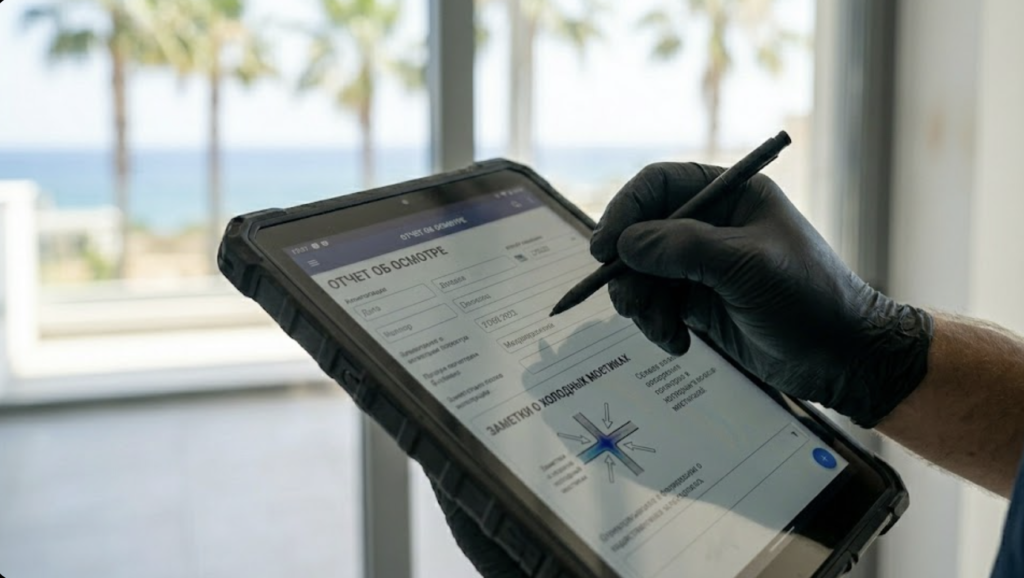
Thermal imaging inspection is an effective non-destructive method that allows specialists to assess hidden systems without disrupting operations. Experts identify zones of abnormal heating that may indicate overloads or installation defects.
Particular attention is given to:
- Electrical connections in distribution panels, where overheating signals improper load distribution
- Hidden air conditioning lines, where leaks can damage finishes in adjacent areas
- Radiators and pipelines, where blockages appear as uneven temperature distribution
Early detection of these issues allows investors to require corrections under the developer’s warranty obligations.
Hidden Risks for Tenants and Investors
Improper insulation can shift the dew point inside walls, leading to condensation and mold growth. For commercial properties, this not only means repair costs but also potential claims from tenants due to poor indoor climate conditions.
Instrumental diagnostics help identify moisture accumulation zones that may only become visible months after operation begins.
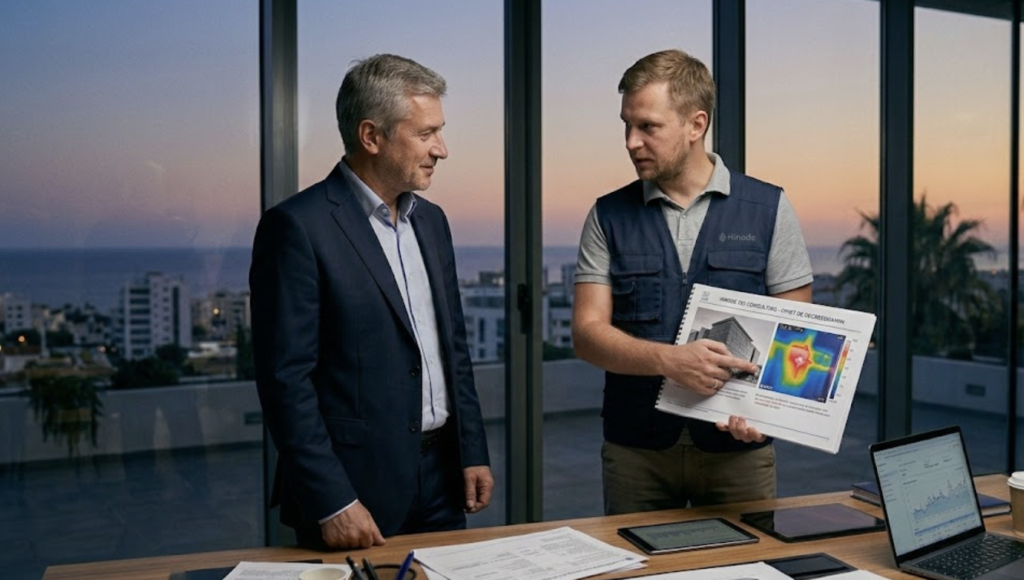
High-sensitivity professional equipment can detect temperature differences of just fractions of a degree. This enables Hinode specialists to accurately assess the scale of defects and estimate the cost of repairs.
Expert Evaluation by Hinode
Hinode’s professional diagnostics follow strict international standards. Each thermal anomaly is verified against project documentation, eliminating false positives caused by reflections or material thermal inertia. This ensures both technically accurate and legally valid results.
The process includes:
- Preliminary review of project specifications
- Calibration of equipment based on environmental conditions
- Preparation of a detailed report with thermograms overlaid on real images
The final report serves as strong evidence in negotiations with developers. Having such documentation significantly increases the chances of prompt defect resolution at the developer’s expense.
Conclusion
Only an independent expert inspection can provide confidence that a commercial property is free from hidden defects. It ensures that your investment is protected and that you are acquiring a high-quality asset, not a visually appealing property with concealed risks.
Hinode inspects commercial properties for hidden defects and risks, protecting your investment.
featured
-
1What differentiates the handover of residential and commercial properties
The property handover process in Cyprus requires an understanding of how the property will be used. In residential apartments, the priority is occupant comfort and health, while in commercial buildings, economic efficiency and system reliability come first. Any deviations in the building’s thermal profile, if unnoticed, can lead to significant future expenses for the owner. […]
-
2How to know during inspection whether mold will appear
The visual cleanliness of walls during a property inspection can be misleading, especially if a cosmetic renovation was done before the sale. Mold is not just an aesthetic issue—it results from serious engineering mistakes that can remain hidden under paint for years. For investors in Cyprus, it is critical to detect biological threats at the […]
-
3Practical examples: What to check during the handover of a residential property
The handover of a property is the final stage of a transaction, where the buyer confirms that the asset is ready for use. In the Cypriot market, where aesthetics often take priority over technical quality, a superficial inspection cannot reveal critical risks. An expert audit should cover not only visible finishing elements but also hidden […]
-
4Practical Examples: What to Check When Accepting Commercial Property
Purchasing commercial real estate is an investment whose profitability directly depends on future operating costs. Unlike residential properties, office buildings and shopping centers in Cyprus are subject to intense эксплуатационные нагрузки. Any flaws in the building’s thermal performance force HVAC systems to operate under strain, increasing electricity costs and accelerating wear on expensive equipment. Key […]
-
5Why Thermal Imaging Is Essential During Property Handover
Accepting a property requires evaluating not only visible finishes but also hidden structural characteristics. Issues with insulation, installation errors in engineering systems, and energy leaks are often impossible to detect without specialized equipment. Thermal imaging diagnostics make it possible to identify such defects at an early stage and prevent future operational problems. What a Thermal […]